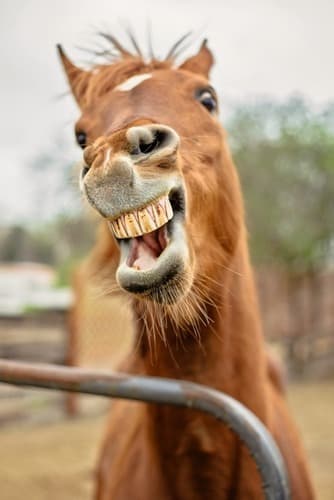
Equine Dentistry
Healthy teeth at your barn
Healthy teeth help your horse to chew, to stay in good condition and to accept the bit. I examine and treat your horse's teeth at its own barn. Your horse stays in familiar surroundings, and you see the findings with your own eyes.
When to reach out
Signs you may notice
Horses are good at hiding mouth pain. Many dental problems show only small signs at first. Please watch for these changes:
When eating
- Food or balls of chewed hay drop from the mouth (quidding).
- Your horse eats more slowly, chews on one side or tilts the head while chewing.
- Your horse prefers soft food and leaves hay.
- Long fibres or whole grains appear in the droppings.
- Your horse loses weight, even though the feeding has not changed.
In the mouth and on the head
- Bad breath from the mouth or the nose.
- A swelling on the face or on the lower jaw.
- A draining tract (a small opening with discharge) on the jaw.
- Nasal discharge from one nostril only, often with a bad smell.
- Red, swollen or receding gums at the front teeth, or loose front teeth.
When ridden or driven
- Head tossing, leaning on the bit, or an uneven contact.
- Your horse opens the mouth, tilts the head or resists the bridle.
- Blood or wounds at the corners of the mouth.
In studies of horses with gaps between the cheek teeth, 76–82% dropped food while chewing (quidding). About one in three had lost weight. [1, 2] Root infections of the upper cheek teeth often cause facial swelling or nasal discharge from one side. Infections of the lower cheek teeth often cause a swelling of the jaw. [3, 4]
Some horses show no signs, even with painful problems. [2] This is why a regular dental check is important, even when your horse eats well.
What regular care can achieve
Regular dental examinations help to find problems early. Many wear problems can be prevented by routine care. Early treatment can help to keep teeth for longer, which matters most in older horses. [12] In a long-term study of 202 horses with painful gaps between the cheek teeth, 72.6% had a complete and lasting remission of their signs after treatment. [2]
Every horse is different. These numbers describe groups of horses, not your horse. An examination shows what your horse needs.
How I help
I am a mobile veterinarian with 13 years of clinical experience and further training in equine dentistry.
At your barn
No transport, and light sedation while standing keeps your horse calm.
A full examination
I check every tooth with a dental camera, not only for sharp points.
A plan for your horse
Together we decide what to treat now and when to check again.
Clear referrals
If your horse needs a CT scan or complex surgery, I recommend a suitable clinic and send all findings.
What we offer
Services overview
How a regular dental visit runs
General check
I check your horse's body condition, head, jaw and lymph nodes, and look for swellings or nasal discharge.
Light sedation
Your horse stands calmly in its stall or the barn aisle. Sedation makes the examination safe and thorough.
Examination
I rinse the mouth, place a mouth speculum, and examine every tooth with a light and the dental camera.
Findings first
I show you the images and explain what I see. Together we agree on the treatment.
Treatment and aftercare
I correct sharp points and overgrowths and treat what we agreed. If X-rays are needed, I can take them at the same visit. Afterwards, please give no food until the sedation has worn off. I tell you how long to wait and what to watch for.
Next check
I recommend the interval that fits your horse, usually every 6 to 12 months.
Surgical cases are planned individually. I examine your horse, take images, and explain the options, risks, costs and aftercare. You decide with full information. If a clinic is the better choice, I will tell you clearly.
How you receive the results
At the barn
I show you the dental images on screen and explain them.
Written report
After the visit, you receive a report with the findings, images and the treatment plan.
Practice app
All diagnostic images are stored in my practice app. You can see them at any time, 24/7.
Reminders
You receive a reminder when the next dental check is due.
My fees follow the GOT (official German fee schedule for vets). Before I start, I tell you the expected costs. If you need it, you get the estimate in writing. A travel fee (Wegegeld) is added. When several horses in one barn are treated on the same day, the travel fee is shared. Read more about fees.
Studies referred to on this page
- Dixon PM, et al. Treatment of equine cheek teeth by mechanical widening of diastemata in 60 horses (2000–2006). Equine Vet J. 2008;40:22-28. doi:10.2746/042516407X239827
- Dixon PM, et al. A long-term study on the clinical effects of mechanical widening of cheek teeth diastemata for treatment of periodontitis in 202 horses (2008–2011). Equine Vet J. 2014;46:76-80. doi:10.1111/evj.12085
- Dixon PM, et al. Equine dental disease part 4: a long-term study of 400 cases: apical infections of cheek teeth. Equine Vet J. 2000;32:182-194. doi:10.2746/042516400776563581
- Dixon PM, et al. Historical and clinical features of 200 cases of equine sinus disease. Vet Rec. 2011;169:439. doi:10.1136/vr.d4844
- Häussling MPP, et al. Equine dental destructive disorders: an epidemiological survey in northern Germany. Front Vet Sci. 2026;13:1706621. doi:10.3389/fvets.2026.1706621
- Rehrl S, et al. Radiological prevalence of equine odontoclastic tooth resorption and hypercementosis. Equine Vet J. 2018;50:481-487. doi:10.1111/evj.12776
- Tretow M, et al. Widespread prevalence of EOTRH detected in German Icelandic horse population. J Am Vet Med Assoc. 2023;261(S2):S102-S107. doi:10.2460/javma.23.05.0301
- Walker H, et al. Prevalence and some clinical characteristics of equine cheek teeth diastemata in 471 horses examined in a UK first-opinion equine practice (2008 to 2009). Vet Rec. 2012;171:44. doi:10.1136/vr.100829
- Rowley KJ, et al. A computed tomographic study of endodontic and apical changes in 81 equine cheek teeth with sagittal fractures. Equine Vet J. 2022;54:541-548. doi:10.1111/evj.13475
- Scantlebury CE, et al. Recurrent colic in the horse: incidence and risk factors for recurrence in the general practice population. Equine Vet J Suppl. 2011;(39):81-88. doi:10.1111/j.2042-3306.2011.00383.x
- Ireland JL, et al. Comparison of owner-reported health problems with veterinary assessment of geriatric horses in the United Kingdom. Equine Vet J. 2012;44:94-100. doi:10.1111/j.2042-3306.2011.00394.x
- du Toit N. Advances in dental management in the equine geriatric patient: strategies for improved welfare. J Am Vet Med Assoc. 2023;261(S2):S114-S120. doi:10.2460/javma.23.06.0350
- Liuti T, et al. Radiographic, computed tomographic, gross pathological and histological findings with suspected apical infection in 32 equine maxillary cheek teeth (2012–2015). Equine Vet J. 2018;50:41-47. doi:10.1111/evj.12729
- Dixon PM. Oral and sinonasal tumors. Vet Clin North Am Equine Pract. 2024. doi:10.1016/j.cveq.2024.07.010
[Placeholder] Image of the dental equipment — to be added when the equipment arrives.
[Placeholder] Video of the dental equipment — to be added when the equipment arrives.
Request a dental appointment
I work in a 25 km radius around Korntal-Münchingen, in parts of Stuttgart and the districts of Ludwigsburg, Böblingen, Esslingen, Rems-Murr, Enzkreis and Calw. Please call me or send a WhatsApp message: +49 1521 4421649. Email: info@tierarztpraxis-ahmad.de